
Mastering the ICP creation and why most of them sucks
Ideal Client Profile has been my constant companion in the past years. How is it built, and why are most of them too generic?

Howl there,
Today’s topic in Jenda’s Den delves into the concept of the Ideal Client Profile (ICP). This term has been a constant companion during my tenure at Kentico. Its frequency of usage has only increased since I transitioned into consulting. It’s a recurrent observation that numerous companies either lack a defined ICP, shooting around, hoping they hit the bear. Or if they do have it, it’s often poorly and broadly defined, causing their target efforts to be haphazard and ineffective.
Understanding the ICP
The ICP is essentially a profile that defines the ideal type of company that would derive maximum benefit from your product or service. It represents the archetype of a customer who will gain the most value from your solution. Simply, the best fit.
Targeting your ICP has multiple advantages for your company. It sharpens your focus, shortens the sales cycle, boosts conversion rates, enhances customer satisfaction, and thus reduces the likelihood of churn. Moreover, it drives sustainable growth. The ICP also plays a crucial role in aligning your internal teams. When everyone has a shared understanding of who the product is being built for and who it’s being marketed and sold to, it helps avoid a myriad of misunderstandings and misalignments.
In contrast to the buyer persona, which defines the role of the individuals in the purchase decision and customer journey, the ICP truly defines the company profile. A chart from Gartner explains this difference:
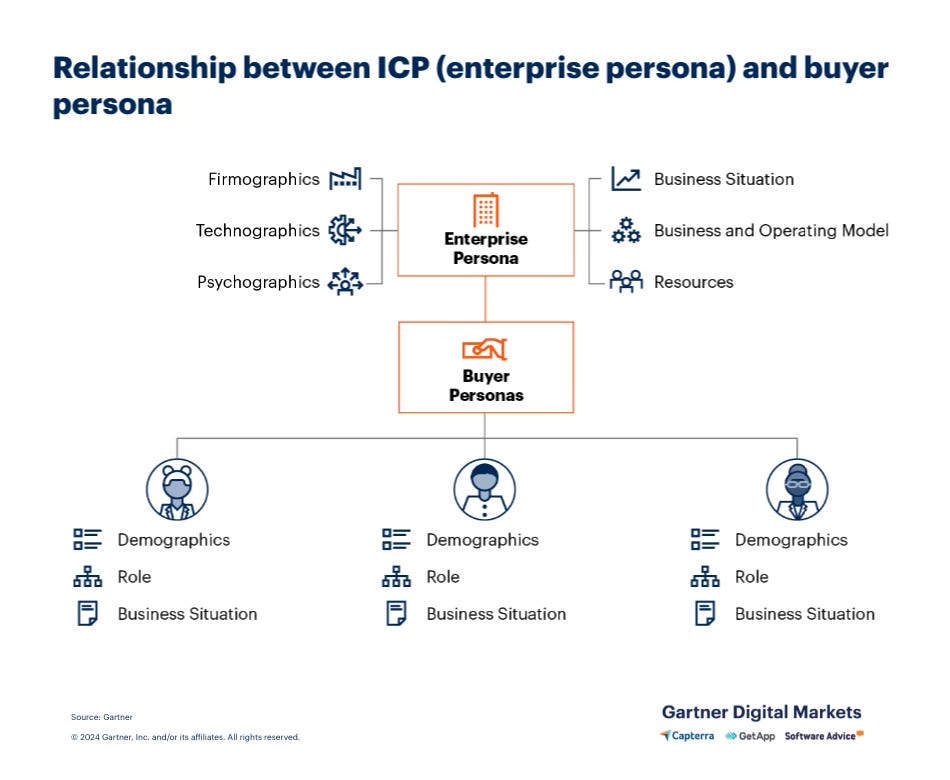
The whole point of ICP is to narrow your focus to enhance results. Therefore, your ICP should be specific and niche enough to provide clear boundaries and limits for your strategy. An essential part of this process involves measuring the impact of narrowing down the focus to determine if your ICP is well-defined. It’s crucial to remember to incorporate your sales cycle length into this measurement.
For anyone starting, there are good enough recommendations on how to build your ICP available on Gartner and Product Marketing Alliance. However, I feel it’s important to highlight some issues I’ve noted with a general approach to defining ICP.
Distinguishing ICP from CCP
First, let’s decipher this new abbreviation. CCP stands for Current Client Profile. If you’re a well-established company with unbeatable results and a definitive market share and penetration, your ICP might closely resemble your CCP. In such cases, I would argue that defining a new ICP to target a fresh market segment is beneficial.
When you analyze your current client data, you’ll likely identify specific segments of customers who perform better than others and some who might be causing unnecessary trouble for your Support, Operations, or Legal teams. Your product might also have evolved to cater to different needs than it did a few years ago.
These are some reasons why you should critically assess the analysis of your current customers. While this is usually one of the first recommended steps in building your ICP, I strongly suggest that you critically evaluate your CCP segments, correlate that with industry-specific market data and predictions, and incorporate changes and future plans for your product or service. This process will quickly help reveal areas where changes to your strategies and tactics are necessary.

Avoiding a broad and generic ICP
There are countless templates for building an ICP. However, a common issue with these templates is that if they aren’t personalized, they can lead to an ICP that’s virtually identical to your competitors or vendors in different segments using the same template.
All of these best practices and templates are a good start—we’ve used them too. While they serve as a great starting point, once the basics are covered, it’s essential to personalize your ICP definition. You must determine what makes your ICP specific and niche compared to your competitors. What signals indicate that a customer will find success with your product beyond the classic firmographics? Is it a specific need, a particular product they currently use, or a unique type of communication on their website?
Firstly, don’t be afraid to get creative. Speak to your current top-performing clients or prospects who have shown a keen interest in your product from the outset. Also, consider the triggers that could ignite interest and the need for your specific solution.
In the past, I saw the maximum size of the Marketing team, the minimum frequency of homepage updates, the maximum number of products in the webshop, a new category added to the portfolio, new roles defined, announced, and hired on LinkedIn, an increase in traffic jams in the areas, or other signals and attributes.
Secondly, focus on quantifying, measuring, and finding the data. Tools like 6Sense, ZoomInfo, Clearbit, Cognism, or Merk (Czech) can assist with basic data. For more specific and personalized triggers and data, you can rely on tools like Salesfit, G2, LinkedIn, media and social listening tools.
Lastly, it’s essential to keep your ICP narrow. Cut, cut, cut. Resist the urge to broaden your ICP just because a salesperson or marketing director thinks you should include another sub-segment. Remember, you’re building a map for your teams to follow, and you don’t want them to aimlessly attempt to “cross the Atlantic Ocean.” They could easily hit an iceberg and end up like the Titanic. Instead, you want to provide them with a straightforward, specific journey to follow.
Implementation and usage tracking
Like any change within a company, introducing and implementing a new or redefined ICP can be challenging. Some employees will quickly understand and adopt it, while others may resist, deny, or ignore it. The worst scenario is that everyone continues their work as they did in the past.
To reap the benefits of a well-defined ICP, you must be strict in implementing and using it. This means explaining the context, benefits, and expectations, providing training, setting boundaries, establishing rules and processes, and measuring not only the results but also deviations.
Always remember that implementing a new ICP across the entire company takes more time than just creating it within a small, focused team or during a management meeting.
So, how does your ICP definition look? Is it effective and actively used within the company, or has it ended up as just another PDF in the company’s cloud?