
Is learning a skill or a mindset? The flaw in Skills-Based Organizations
Udemy's pioneering Skill-Based Organizations. Why is it more about the mindset?

Howl there,
Greetings from the House of Rezac's Strategic Thinking training, where we are deeply immersed in intriguing strategic frameworks like Wardley Maps, 7 Powers, and Cynefin. Having left Kentico just four months ago, I've concentrated on some personal growth, developing new skills, enriching my experiences, and expanding my intellectual and perspective horizons within this period. So today, I invite you to join me in a conversation about the role of skills, education, and attitude in our professional lives.
A spark that ignited this topic was Udemy's 2024 Global Skills Insights Report (yes, I downloaded it – learning addict here!). As one of the leaders in the online learning market, alongside Coursera, Udemy champions the skills-based approach and advocates for skills-based training programs in the companies. To ensure a comprehensive perspective, I also sought out Coursera's equivalent report, dated June 2023.
Unsurprisingly, Udemy's report champions the cause of a skill-based economy and skill-based organizations. They propose a shift from “We need people who can fill these jobs” to “We need people who have these skills.” It's a compelling argument, but how do we go about creating and managing such organizations?
The skills landscape is complex and ever-changing, making it challenging to understand what skills employees already have, what gaps exist with the skills they need — and more important still, how to address these gaps. The World Economic Forum Future of Jobs Report 2023 found that 6 in 10 employees will require training before 2027, and half of those individuals don’t have access to adequate resources to make that happen. Add to this, Deloitte found that only 5% of executives believe they are investing enough to help their teams learn the new skills needed to keep up with the changing world of work.
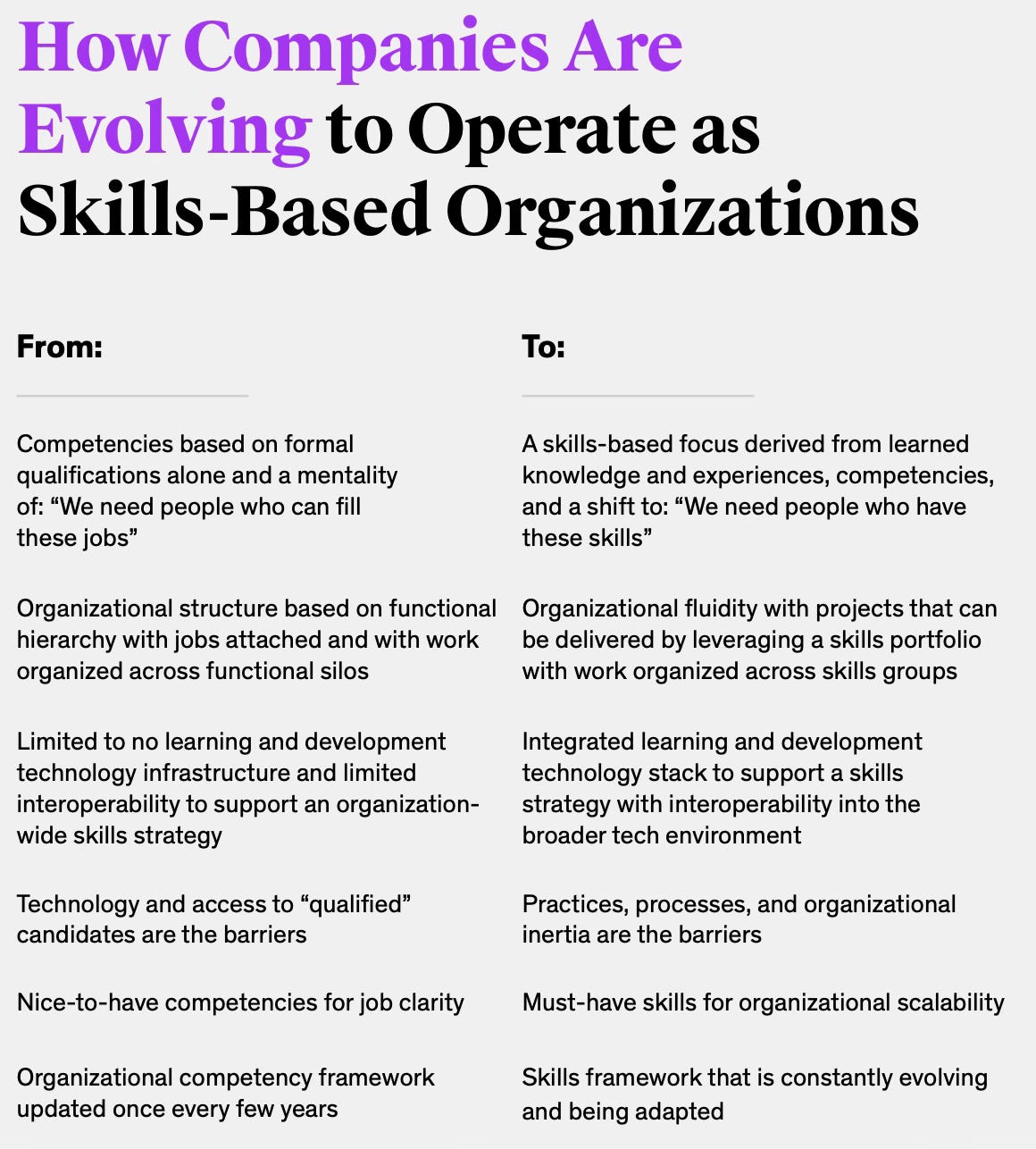
While there's a significant emphasis on practices, processes, and hard skills, it seems the conversation about fostering an environment conducive to learning new skills is sidelined. I've heard numerous companies extolling their support for employees' development. They proudly state they provide both time and financial resources, assuring they create an environment that fosters the application of new skills. However, when you look closer, the reality often paints a different picture. It’s often just employer branding bullshit.
In my view, cultivating a robust learning environment and embedding it deep within a company's culture and values is crucial.
Udemy's report identifies several top trend in skills. Of course, AI is the first of them. But it also highlights the increasing focus on developing leadership skills to build resilient organizations in today's whirlwind of exponential changes. Interestingly, Coursera's report reveals that learners in high-income countries are more inclined to invest in learning human skills. Conversely, individuals in less economically developed countries tend to focus more on technical and digital skills. This highlights a fascinating global skills gap. It's not just about the what, but the why behind skill development.
In a recent online discussion breakfast hosted by the Red Button EDU professionals network in February, we delved into the topic of the different starting lines in education. Mostly discussed in the context of Central Europe and its various socioeconomic groups, these insights resonate with the findings of Udemy's and Coursera's reports, in my opinion.
Another crucial takeaway from the discussion was the idea that the stand-out performers are not simply those who just deliver results now but those who are open to and capable of learning new concepts and skills. You need people who are able to focus on exploring and developing new skills, not just the skills themselves, because the needs are changing. The real differentiator isn’t just the skills people possessed, but their openness to continuous learning. Isn't a culture of lifelong learning more valuable than a static "skills-based" box?

So, this brings us to the question: Is learning a skill? Is it an attitude, a talent, or a mindset? Can we learn how to learn?
Without a doubt, we can learn effective ways to absorb and retain new knowledge and skills. There are myriad tips, tricks, processes, and learning styles available. However, they are not universal. What works for one person may not work for another. Thus, learning cannot be viewed as a generic skill that can be mastered in the same way as, say, coding in a new programming language.
Let's revisit the topic of the different starting lines. Before anything else, a positive attitude towards learning is essential. You probably know someone who loves to soak up new knowledge like a sponge. You might also know someone who resists any new approaches, sticking to the tried and true methods they've used for years. These mindsets are influenced by our backgrounds and talents. They are not skills.
Finally, the application of newly acquired knowledge or skills is instrumental. It's fantastic to read numerous books and newsletters, listen to a plethora of podcasts, and attend countless courses. However, all this is in vain if you don't put it into practice. I believe this is a matter of habit and routine. You can devise ways to implement theories, and again, these methods can vary from person to person. But what matters is the consistency in doing so.
Have you discovered any intriguing or provoking insights in Udemy's and Coursera's reports? Do you consider learning a skill? And what new skills are you focusing on this year? Let's redefine what a future-proof workforce looks like. Share your thoughts! Are skills-based organizations enough? How can we cultivate a culture that prioritizes continuous learning and adaptability?